
Every March, students in Years 3, 5, 7 and 9 across Australia sit NAPLAN, the National Assessment Program for Literacy and Numeracy. For most families it arrives as a note from school, a few days of tests, and a report later in the year that is hard to interpret. This guide explains what the tests actually involve, how the results are worked out, when they matter more than schools tend to say, and how to help your child prepare in a sensible way.
If you'd rather see the tests than read about them, we've built free NAPLAN-style practice tests for every year level and every section, laid out like the online test.
When it happens
NAPLAN moved from May to March in 2023, so that schools get results back earlier in the year. The test window runs over nine school days. In 2026 it ran from 11 to 23 March, and the 2027 window is 10 to 22 March 2027. Writing is always first, followed by reading, conventions of language and numeracy, in that order.
The four tests
| Test | Year 3 | Year 5 | Years 7 and 9 |
|---|---|---|---|
| Writing | 40 min | 42 min | 42 min |
| Reading | 45 min | 50 min | 65 min |
| Conventions of language | 45 min | 45 min | 45 min |
| Numeracy | 45 min | 50 min | 65 min |
Writing. Students write one piece, either a narrative (a story) or a persuasive text. Nobody knows which genre it will be until the test starts, and there's no choice on the day. Years 3 and 5 get the same prompt, and Years 7 and 9 share another. Everyone gets 40 minutes of writing time, and students sitting the test online get two extra minutes to read the prompt, which is why the official times for Years 5, 7 and 9 say 42.
Reading. Students read a set of texts (stories, information reports, poems, persuasive pieces) and answer questions about them. The questions range from finding a detail in the text to working out what a writer is implying, why a word was chosen, or what the whole piece is trying to do.
Conventions of language. This is spelling, grammar and punctuation. Spelling comes first and includes questions where a word is read aloud and the student types it, plus proofreading questions where they find and fix a misspelt word. Once a student moves past the spelling section, they can't go back to it.
Numeracy. Number and algebra, measurement and geometry, statistics and probability. Years 3 and 5 don't use a calculator. In Years 7 and 9, the test starts with a short section without a calculator, then an on-screen calculator unlocks for the rest, and students can't go back to the first section.
Online, and tailored
All of the tests are done on a computer or tablet, except Year 3 writing, which is still on paper. The reading, conventions and numeracy tests are tailored: everyone starts on the same set of questions, and depending on how they go, the test branches twice into harder or easier sets. Two children in the same class can see quite different questions.
This is the part most parents don't know about, and it matters for how the results work. A child's result depends on how many questions they got right and how difficult those questions were. Getting through to the harder branch and doing reasonably well on it scores higher than acing the easier branch.
How the results are worked out
Each test produces a score on a national scale that runs across all four year levels, so a Year 5 result can be compared with the same child's Year 3 or Year 7 result. Since 2023, results are reported in one of four proficiency levels for each test:
| Proficiency level | What it means |
|---|---|
| Exceeding | The student's result is well above what's expected at this point in schooling. |
| Strong | A solid result that meets challenging but reasonable expectations. |
| Developing | The student is working towards expectations. |
| Needs additional support | The student isn't achieving the expected level and is likely to need extra help. |
These levels replaced the old ten-band system and the "national minimum standard" in 2023, and the scale was reset at the same time. That means a 2025 result can be compared with a 2023 result, but not with anything from 2022 or earlier.
Reading your child's report
Families usually get the individual student report through their school. The main page is a set of side-by-side columns, one for each test, with Conventions of Language split into Spelling and Grammar and punctuation. It looks roughly like this:
- Numeracy: Strong
- Reading: Exceeding
- Writing: Developing
- Spelling: Strong
- Grammar and punctuation: Strong
Here's how to read it:
- The blue column is the four proficiency levels, with Exceeding at the top and Needs additional support at the bottom.
- The black dot is your child's result. The report doesn't print a number, so where the dot sits is the result.
- The triangle marks the national average for that year level.
- The pale box is where the middle 60% of students in Australia landed. A dot above the box puts your child roughly in the top fifth nationally for that test, and a dot below it roughly in the bottom fifth.
In the example above, this student is comfortably Strong or Exceeding in Numeracy, Reading and Conventions, but their Writing dot sits in Developing, below the national average. That pattern is common, and it tells you far more than any single label: the student reads and calculates well but hasn't yet learned to plan and shape a piece of writing under time pressure. The report also includes a short description of what each test assessed and a page describing the skills typical of each level, which is worth reading next to the graph.
How writing is marked
Writing can't be marked by a computer. Trained markers, mostly current or former teachers, score each script against ten criteria. For a narrative, the criteria and maximum scores are:
| Criterion | Max score |
|---|---|
| Audience | 6 |
| Text structure | 4 |
| Ideas | 5 |
| Character and setting | 4 |
| Vocabulary | 5 |
| Cohesion | 4 |
| Paragraphing | 2 |
| Sentence structure | 6 |
| Punctuation | 5 |
| Spelling | 6 |
For a persuasive piece, "character and setting" is replaced by persuasive devices, and paragraphing is worth a little more. Two things stand out from this table. First, nearly half the marks are about craft (audience, ideas, structure, vocabulary), not technical accuracy. Second, sentence structure and spelling are each worth as much as audience, so a creative story full of run-on sentences and careless spelling loses a lot.
Does NAPLAN actually matter?
For your child's school report and their progression from year to year, no. NAPLAN doesn't count towards grades, and schools use it mainly to check how students and programs are tracking. ACARA itself says students aren't expected to study for it.
But it isn't true that NAPLAN never matters, and Year 5 is the one to watch. Applications for selective and scholarship entry into Year 7 happen while children are in Year 5 or early Year 6, so the Year 5 report is often the most recent one a family can attach. Some examples from Brisbane, based on what schools currently publish:
- Brisbane State High School asks Year 7 Academic Selective Entry applicants to submit their child's Year 5 NAPLAN report, and applicants for Years 8 to 11 to submit their most recent one. The selection test result is the main criterion, but the report is part of the file. (Our guide to Brisbane State High out-of-catchment entry covers the process.)
- Queensland Academies (QASMT) lists NAPLAN results, where available, among the documents for Year 7 entry, and assesses applicants on school reports and academic data such as NAPLAN alongside the entrance test. Year 5 NAPLAN may be requested after you apply. See our QASMT Year 7 entry guide.
- Brisbane Grammar School asks academic scholarship candidates to submit their two latest school reports and NAPLAN results.
- Ormiston College asks for Year 3 and Year 5 NAPLAN results as part of its Year 7 scholarship portfolio.
- Brisbane Girls Grammar School makes offers of a place conditional on school reports and NAPLAN results that show successful completion of the previous two years.
Plenty of other schools don't mention NAPLAN in their scholarship requirements at all, and for most scholarships the entrance exam (usually ACER or EduTest) carries far more weight. Our post on EduTest and ACER scholarship exams explains those. Still, a Year 5 report that says "Exceeding" across the board supports an application, and one with a "Developing" in reading or numeracy is something a selection panel will notice. Requirements change from year to year, so check each school's current documents before you apply.
How to prepare, without overdoing it
The honest answer is that the best NAPLAN preparation is being a capable reader, writer and mathematician, and that takes longer than a few weeks of practice papers. But there are a few specific things that make a real difference.
Get familiar with the format. Knowing how the screen works, how to flag a question and come back to it, and what the calculator section looks like takes the surprise out of test day. ACARA runs an official public demonstration site with sample tests for each year level. Our practice tests use the same kind of layout and mark the multiple-choice sections straight away, with an explanation for every answer.
Practise writing to time, in both genres. Forty minutes goes quickly. A good routine is about 5 minutes planning, 30 minutes writing and 5 minutes checking. Because the genre is a surprise, your child should be comfortable with both a story and a persuasive piece. For Years 5, 7 and 9, typing speed matters too: a child who types slowly has less time to think. Year 3 students write on paper, so handwriting practice is still the right preparation for them.
Read widely, and talk about it. Reading questions reward children who notice why a writer made a choice, not just what happened. Asking "why do you think the author started with that?" or "how did they make you feel sorry for him?" builds exactly the skill the harder questions test.
Lock in the basics in maths. Fast recall of times tables and number facts frees up working memory for the reasoning questions. For Years 7 and 9, practise the non-calculator skills specifically (fractions, percentages, order of operations), since that section comes first.
Keep it in proportion. A child who is anxious about NAPLAN won't perform better for it. Treat it as a check-up, and use the results as information about what to work on next.
Useful links
Official information from ACARA, the authority that runs NAPLAN:
- NAPLAN overview: what the program is and who sits it.
- Information for parents and carers: ACARA's own guide, including how to ask about exemptions and adjustments.
- What's in the tests: the four tests and what each one assesses.
- Test window and key dates: when this year's tests run.
- How tailored tests work: why the online test changes difficulty as your child goes.
- Results and reports: the proficiency levels and the individual student report.
- Public demonstration site: sample questions in the real online player.
Free practice from us:
- NAPLAN practice tests: Writing, Reading, Conventions of Language and Numeracy for Years 3, 5, 7 and 9, each in a short version and a full-length one, marked straight away.
- All our free resources: the practice tests plus our ATAR calculator and linear equation visualiser.
- NAPLAN preparation classes: how we build NAPLAN practice into our primary Maths and English program.
Where we can help
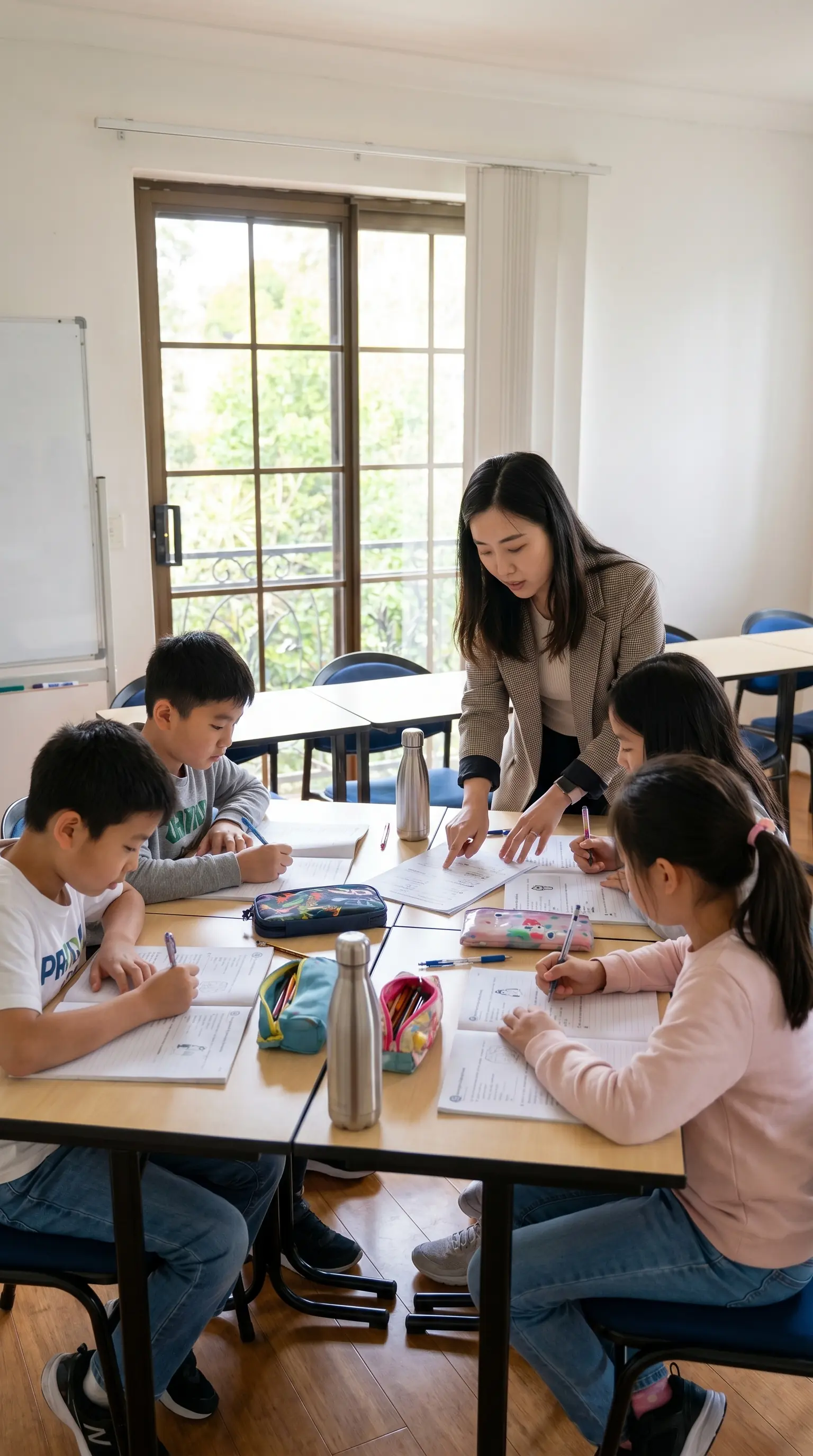
NAPLAN preparation is built into our primary Maths and English classes at our Mansfield and Stretton campuses: weekly practice of the question types, timed writing with feedback against the marking criteria, and steady work on the reading and maths skills underneath. If your child does a writing task in our practice tests, you can send it to us for feedback, and current students can bring it to class. You can read more about our NAPLAN preparation or enrol for a trial class.
Written by the tutors and teachers at Lee Excellence Education. Test details, timing and the writing criteria follow ACARA's published information and the NAPLAN 2025 Technical Report; school requirements are as published by each school in late 2026. Check with ACARA, your school and each school's enrolment office for the current details.